Secret Negotiations Between the Allies and the Nazis
Operation NapoleonSecret Negotiations Between the Allies and the Nazis were a late-war attempt to explore cooperation against the Soviet Union, conducted while Germany was nearing defeat and the Red Army advanced into Eastern Europe. Their concealed purpose was known to only a small circle; the operation built around them left even Colonel Miller, an intelligence officer carrying out a crucial assignment, ignorant of what the mission ultimately meant. The negotiations’ uncertain terms and the flight intended to serve them are later reconstructed through Miller’s recollections, hearsay, and the remains of a lost aircraft.
Origins and strategic context
By the final phase of the Second World War, the approaching defeat of Nazi Germany had opened a new and bitter question among the Allies: how Europe would be divided between Allied- and Soviet-occupied territories. As Soviet forces moved through Eastern Europe, some began to consider whether Germany could be turned against the Soviet Union before the war’s end. General Patton was the only person Miller knew to have floated an attack on Russia openly, but, in Miller’s account, no one took him seriously. War-weary leaders wanted peace, even as the possibility of a further conflict was discussed.
The Germans, for their part, feared that the Soviet Red Army would reach Berlin first. They were in no position to dictate a ceasefire, but some were prepared to join the Allies in the war’s final months if they could trust the Allies to turn against the Russians. Miller understood this as a request from a defeated power, not as a negotiation between equal sides. The possible bargain joined German fear of Soviet occupation to Allied calculations about what might follow Germany’s collapse.
Intermediaries and uncertain proposals
Miller’s account identifies Count von Mantauffel, a Swedish count, as an intermediary between the Allies and the Nazis. He could not say whether the idea began with the count, with the Nazis, or with others. Heinrich Himmler wanted an agreement against the Communists and expected to emerge as head of a new government. Miller also believed that Winston Churchill had drafted a plan to attack Russia with German support, and that the proposal may have taken shape after that plan. He presented these origins as uncertain, not as a settled record of who initiated the negotiations or controlled them.
The historical precedent that gave the secret plan its name was Napoleon. That reference did not resolve the negotiations’ purpose; it marked the possibility of an extraordinary political arrangement whose details remained obscure even to people assigned to carry it out. Miller could not confirm whether the suggestion that Adolf Hitler’s life should be spared formed part of the negotiations, whether Hitler was to be handed to the Allies to smooth them, or whether Britain and the United States were competing with the Soviet Union to reach him first. He allowed that there might have been another, less apparent reason. The surviving account thus preserves alternatives rather than a definitive explanation.
Operation Napoleon and the flight
The negotiations were connected to a plan involving a German delegation and a flight to Iceland. Miller’s brother was chosen as pilot because he knew the route and could make contact with Allied air-traffic control. Miller believed the mission would bring them together in Reykjavík before they continued to South America for leave; he did not know the agenda of the talks or the identities of those attending a meeting in Paris. He had been given only a specific assignment, while the purpose behind it remained hidden from him.
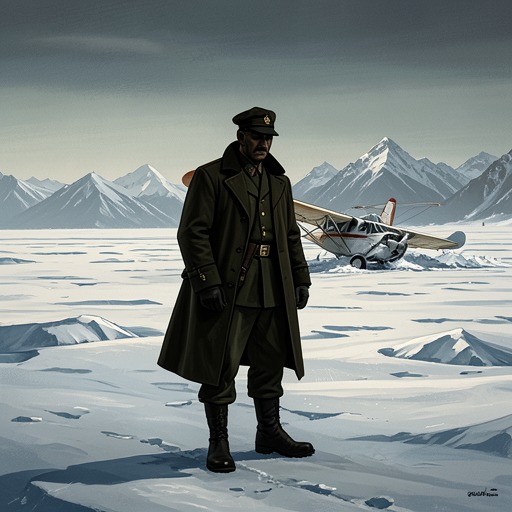
The plan first called for the Germans to provide an Allied aircraft in their possession. That approach was abandoned in favour of painting a Junkers Ju 52 in Allied colours. Miller reached Iceland with two intelligence agents before his brother was due to fly the German delegation from Berlin. They stayed at Hotel Borg, avoided the many American servicemen in Reykjavík, and inspected the British-built aerodrome at Vatnsmýri. The aircraft was expected to stop for three hours to refuel and take on provisions before continuing west. A developing storm changed the circumstances: after the plane left Berlin, air traffic control at Prestwick last made contact with it north of Scotland, and it was not heard from again. Brothers in the village of Höfn later reported seeing a plane fly so low that it must have crashed on the glacier.
Secrecy, evidence, and aftermath
The operation’s compartmentalization shaped what could be known about it. Miller said that only a tightly controlled number of Army personnel knew about Operation Napoleon; he himself never knew exactly what it involved or what the documents contained. He described himself and his brother as pawns, sent to solve a particular problem without access to the larger design. His later account therefore combines a limited first-hand understanding of his assignment with information learned through hearsay and retrospective inference.
The aircraft’s disappearance did not end the effort to keep its history obscure. During later surveillance, monthly flights photographed the southeastern part of Vatnajökull, and rumours circulated that the military was searching for a plane with dangerous cargo. Leo Stiller organized those flights; he told Sarah Steinkamp that the aircraft on the glacier belonged to the Nazis. Years later, documents recovered from a weather-damaged metal case were mostly illegible, but the words Operation Napoleon could still be made out. Their fragmentary condition offers a material trace of the secret without settling its full meaning. In the later recovery operation, Colonel Miller was told that the aircraft had reappeared from the glacier and that its bodies and documents were to be brought back; even then, the handling of the papers remained controlled. The negotiations persist in the story as both a concealed political project and an incomplete history reconstructed from guarded testimony, rumour, and damaged evidence.